
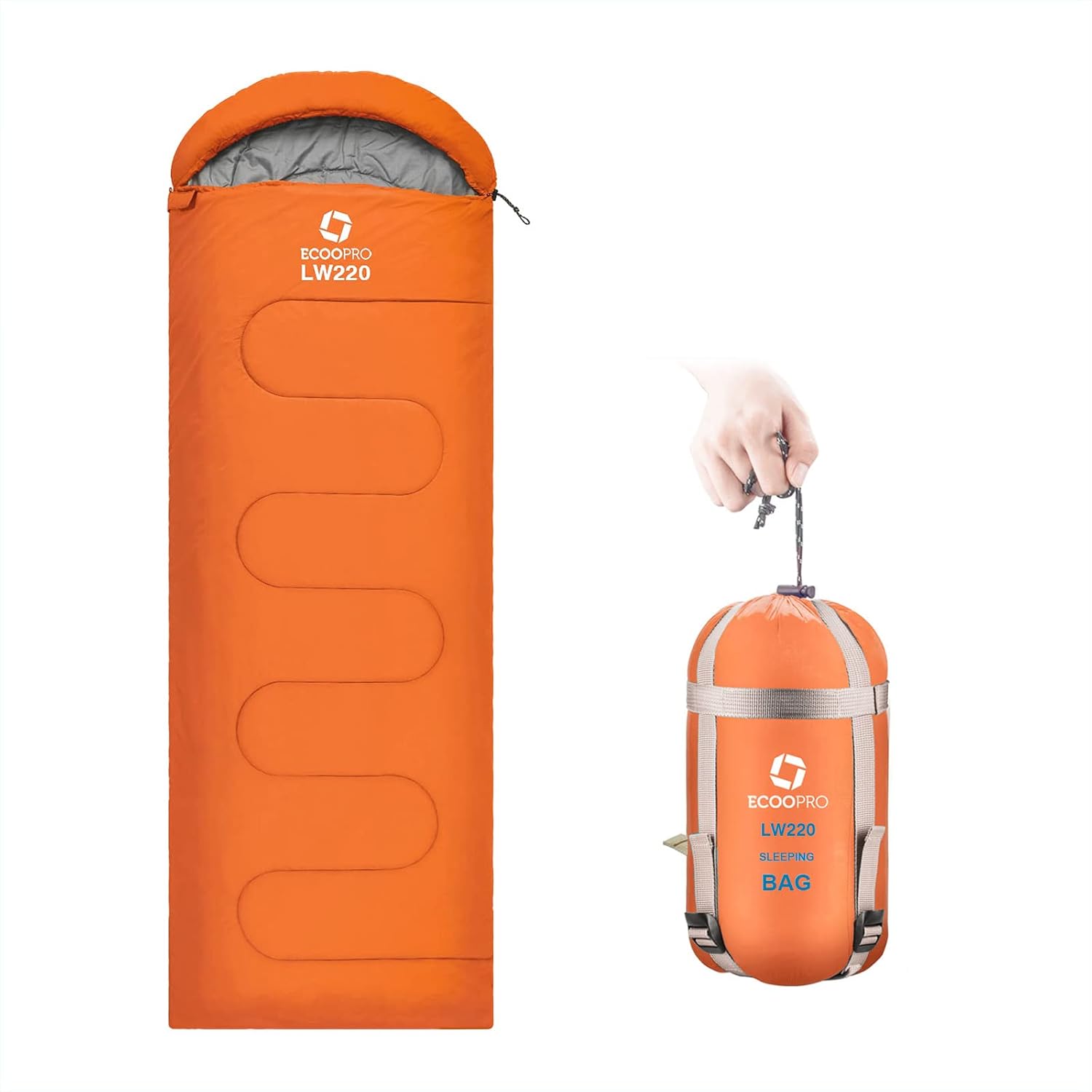
ECOOPRO Warm Weather Sleeping Bag
The ECOOPRO Warm Weather Sleeping Bag may suit you if you want a low-cost bag for mild conditions. That range is not presented as a verified EN or ISO rating, so you should treat it as a product claim rather than a standardized comfort result. The listing also gives a 1.5-pound item weight.
- The listing claims a temperature range of 55–60°F and labels its temperature rating “Comfort,” without a separate rating value.
- The specifications list polyester fill, nylon fabric and an envelope shape.
- The listed item weight is 1.5 pounds; dimensions are 83 by 30 inches.
Details from the Amazon product listing, checked November 7, 2026.
Quick verdict
Don’t rely on the listing as evidence of an EN or ISO rating, verified temperature performance, or suitability for colder conditions; those points aren’t established by the available claims.
Before you buy
- Treat the 55–60°F figure as a listing claim, not a verified standardized rating.
- Compare the listed 1.5-pound item weight with the separate compression description of 1.7 pounds; the listing doesn’t explain the difference.
- The listing identifies polyester fill, an envelope shape, and use without a liner, but supplies no comparative performance data.
What we like
- The specifications list a 1.5-pound item weight and describe the bag as lightweight and compressible.
- The bag is listed with polyester fill and an envelope shape.
- The product description says it can be used without a sleeping bag liner and can also work as a camping comforter.
Worth checking
- The listing’s Comfort temperature-rating label has no separate rating value, and no EN or ISO rating claim appears in the available details.
- The product description’s compressed weight of 1.7 pounds differs from the separate 1.5-pound item-weight specification; the listing doesn’t explain the discrepancy.
- The available claims provide no comparative performance data against down bags, liners, or other alternatives.
What temperature range qualifies a sleeping bag as suitable for warm-weather camping?
Warm-weather suitability depends on the conditions you expect and the temperature information available for the specific bag. ECOOPRO says the polyester fill keeps the temperature from 55 to 60°F, but that wording is a listing claim, not a result independently verified here. The Warm Weather Sleeping Bag listing labels its temperature rating “Comfort,” yet gives no separate value for that label.
That leaves you with a useful but limited reference: the claimed 55–60°F range. It doesn’t establish how comfortable every sleeper will be, or what conditions the bag can handle outside that range. The Warm Weather Sleeping Bag may be worth considering for trips where the expected night conditions align with the claim, but the available details don’t establish a broader safe or comfortable operating range. If your plans could include colder weather, don’t infer cold-weather performance from the listing alone. The Warm Weather Sleeping Bag’s temperature information is best read as a starting point for comparison, not a guarantee.
How do EN or ISO temperature ratings indicate whether the Warm Weather Sleeping Bag will be comfortable on a warm night?
The available listing does not claim an EN or ISO temperature rating for the ECOOPRO bag. It labels the temperature rating “Comfort,” but supplies no separate numerical value for that label. That distinction matters: the Warm Weather Sleeping Bag’s claimed 55–60°F range appears in the product description, while the specifications provide only the Comfort label.
So you can compare the stated range with the conditions you expect, but you can’t treat it as a verified standardized rating based on the provided details. The Warm Weather Sleeping Bag has no cited EN or ISO result here, and no independent test result is available in the claims. That doesn’t prove the product would be uncomfortable; it means the evidence doesn’t establish standardized performance. If you need a rating you can compare directly with another bag’s standardized figures, that information is unavailable for this product. The Warm Weather Sleeping Bag’s listing claim should remain separate from any verified rating.
Is down or synthetic insulation better for a warm-weather sleeping bag?
The ECOOPRO bag is listed with polyester fill, which is a synthetic material. Its product description contrasts the envelope bag with down sleeping bags, but provides no comparative performance data. That means the listing supports identifying the fill, not declaring polyester or down the better choice for warmth, comfort, packed size, or other performance.
For the Warm Weather Sleeping Bag, the practical evidence is limited to the polyester specification and the manufacturer’s stated temperature claim. The Warm Weather Sleeping Bag description says it can be rolled into a carrying sack and compressed, but it gives no side-by-side test against a down alternative. If you’re choosing between insulation types, don’t read the contrast as proof of an advantage: the available claims don’t establish one. The Warm Weather Sleeping Bag is a polyester-filled option; comparative warmth, durability, and packing performance are unavailable. Your choice between synthetic and down therefore can’t be settled by this listing alone.

What sleeping bag weight, shape, and packed size are best for warm-weather backpacking?
The ECOOPRO specifications list a weight of 1.5 pounds and dimensions of 83 by 30 inches, and identify the shape as envelope. Those are concrete listed details to compare with your own packing needs, but the claims don’t establish what weight or shape is best for every backpacker.
The description says the Warm Weather Sleeping Bag compresses to 11 inches in height and 1.7 pounds, which differs from the separate 1.5-pound item-weight specification. The listing doesn’t explain the difference, so treat the compression description and item-weight figure as separate claims rather than combining them. The Warm Weather Sleeping Bag is described as lightweight and compressible, but no packed width or full packed dimensions are supplied. The Warm Weather Sleeping Bag may interest you if its stated dimensions and listed weight fit your plans; whether the packed size works for your pack remains for you to assess, since further measurements are unavailable.
 Play video: Product video
How much does a warm-weather sleeping bag typically cost, and which features affect the price?
Those figures describe this product, not the typical price of warm-weather bags: no comparable product prices are provided in the available claims. So the Warm Weather Sleeping Bag can be assessed against its own listing price, but a market-wide price range is unavailable.
The listing identifies polyester fill, nylon fabric, an envelope shape, and a compression sack. However, the available information doesn’t establish how much any of those features affects typical prices, or whether they make this option better value than another bag. The Warm Weather Sleeping Bag price should therefore be considered alongside the specifications you care about, without assuming a feature-based price premium. If you’re comparing products, you’ll need comparable current prices and details; none are included here. The Warm Weather Sleeping Bag’s listed price and its listed features are verifiable from the claims, while the broader pricing context is not.

How should you use a sleeping bag on a hot night to avoid overheating?
The ECOOPRO description says the bag can be used without a sleeping bag liner, but it doesn’t provide specific instructions for hot-night use. The lining is described as polyester and breathable; that is a product-listing claim, not a verified performance finding. The Warm Weather Sleeping Bag’s available details therefore don’t tell you exactly how to adjust it if you feel too warm.
You can take the no-liner statement as the manufacturer’s suggested use, not as a tested hot-weather strategy. The Warm Weather Sleeping Bag has a zipper closure listed, but the available information doesn’t explain whether or how opening it changes comfort. No specific advice about clothing, ventilation, or adjusting coverage appears in the claims, so those instructions are unavailable. The Warm Weather Sleeping Bag description mentions use in multiple weather conditions, but it doesn’t define those conditions or provide hot-night guidance. Treat the breathable-lining description as a claim, and don’t mistake it for proof that the bag prevents overheating.

What are the trade-offs of choosing a lightweight, low-temperature-rated bag for warm-weather trips?
The ECOOPRO listing describes the bag as lightweight and compressible, and its specifications give an item weight of 1.5 pounds. The product description claims a 55–60°F temperature range, but the temperature-rating field gives only the label “Comfort,” with no separate value. No standardized rating or independent test is available in the claims.
That makes the Warm Weather Sleeping Bag’s stated low-temperature information a point to check against your plans, not a verified promise of comfort. Its listed weight may be relevant if you’re trying to limit carried weight, while the claimed compressibility may be useful to consider; neither description establishes how it will perform for your particular trip. The Warm Weather Sleeping Bag’s performance in colder conditions is not established by the available data. The Warm Weather Sleeping Bag may fit a warm-weather use case if the stated range suits your expected conditions, but the evidence doesn’t support relying on it for colder trips.
When is a sleeping bag liner or sleeping bag alternative a better choice for warm conditions?
The ECOOPRO description says the bag can be used without a sleeping bag liner and can also work as a camping comforter. It doesn’t compare either option with a separate liner or another sleeping-bag alternative, so the available claims can’t establish when one would be better.
The Warm Weather Sleeping Bag may appeal if you want the listed option of using a bag without a liner, but the description doesn’t explain which temperatures or conditions that advice covers. The comforter use is also a product-description claim, not a comparative test. For warm conditions, you’ll need to decide whether you want a full bag or an alternative based on your needs; guidance comparing warmth, packability, or comfort between them is unavailable here. The Warm Weather Sleeping Bag listing supports the two stated uses, but not a conclusion that they outperform a liner or another option. The Warm Weather Sleeping Bag’s suitability for your trip still depends on conditions the listing doesn’t define.

Frequently asked questions
What temperature range does the ECOOPRO bag claim?
The listing claims a range of 55–60°F, while its temperature-rating specification says “Comfort” without a separate value.
Does the listing provide an EN or ISO temperature rating?
No EN or ISO rating claim appears in the available product details; the listing gives a Comfort label without a separate numerical rating.
How much does the bag weigh, and what are its dimensions?
The specifications list the item weight as 1.5 pounds and dimensions as 83 by 30 inches.
Can you use the bag without a liner?
Yes. The product description says it can be used without a sleeping bag liner, but gives no specific hot-night instructions.
Ready to take a look?
Check the current price, options and delivery for the ECOOPRO Warm Weather Sleeping Bag.


